Mermaid Tail Scales Digital Backgrounds: A Design Deep Dive
There’s a certain quality to underwater light—the way it filters, refracts, and creates a world of shifting color and texture. For designers and creators, capturing that ethereal, fluid feeling can be a powerful tool. This is precisely where Mermaid Tail Scales Digital Backgrounds come into play. More than just a simple pattern, this collection is a set of design assets built to evoke a specific, enchanting atmosphere. Let's explore what these digital papers offer and how they can transform your creative projects from ordinary to oceanic.
Anatomy of an Aquatic Asset
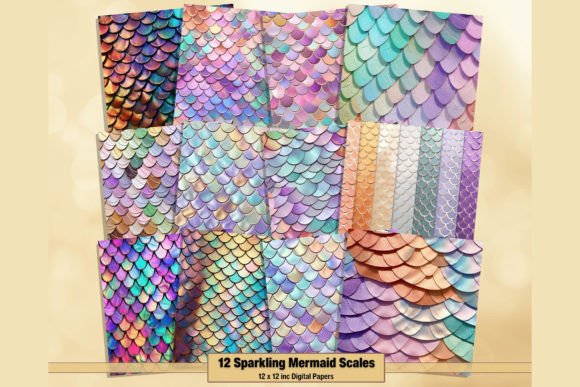
At its core, the collection consists of twelve 12x12 inch JPG files, each rendered at a minimum of 500 DPI. This technical specification is crucial. High resolution means these textures won't pixelate or blur, even when scaled for large-format printing or detailed digital work. The visual personality is unmistakable: think iridescent gradients, layered pearlescent effects, and the intricate, repeating geometry of fish scales. It’s a creative font in visual form—a texture that speaks a language of fantasy, nature, and shimmering detail.
The style walks a line between photorealistic and artistically stylized. You’ll find papers that mimic the wet, glossy look of a real tail, alongside others that adopt a more illustrated, almost vintage aesthetic with softer, watercolor-like blends. This versatility is key. It allows the same asset to feel fresh and modern for a tech startup’s social media campaign or nostalgic and whimsical for a children’s book publisher. The overall appeal lies in its ability to suggest movement and depth, adding a layer of tactile interest that flat colors or standard gradients simply cannot achieve.
Strategic Applications: Beyond the Scrapbook
While perfect for junk journaling and card making, the true power of these backgrounds is unlocked when applied strategically across professional and personal projects. Think of them as a specialized typeface for your visual background—they set the tone before a single word is read.
- Branding & Identity: For a brand centered around wellness, spa services, marine biology, or fantasy storytelling, these scales can become a foundational element of the brand identity. Use them as website hero backgrounds, packaging textures for artisanal goods, or as subtle overlays in logo design to add a unique, memorable character.
- Marketing & Social Media: In the crowded space of social media graphics, a striking background stops the scroll. These textures are ideal for quote cards, promotional banners, or video thumbnails in niches like travel, beauty, or entertainment. They provide instant thematic context without overwhelming the foreground message.
- Publishing & Editorial Design: Authors and publishers can use these for book cover backgrounds, especially in fantasy, romance, or children’s genres. In editorial design, they can serve as section dividers in magazines or as textured backgrounds for pull quotes, adding a touch of luxury and intrigue to the layout.
- Digital & Print Products: The applications extend to physical products. Imagine these patterns on notebook covers, phone cases, or fabric prints. For digital creators, they are perfect for designing printable planners, journal kits, or desktop wallpapers, offering a cohesive and immersive user experience.
Practical Implementation for Maximum Impact
Integrating a strong texture like this requires a thoughtful approach to maintain readability and visual harmony. Here’s how to use Mermaid Tail Scales Digital Backgrounds effectively.
Font Pairing is Critical. A busy, detailed background demands a clean, highly legible foreground font. Pair these scales with a sturdy sans serif font for body text or a bold, simple serif font for headlines. Avoid intricate script fonts or overly decorative handwritten fonts for primary text, as they will compete for attention and hurt readability. The background is the supporting actor; your typography must be the clear, confident star.
Master Visual Hierarchy. Use the textured background to create depth. Place key text or graphics in areas of the pattern that are less busy or slightly lighter. Employ solid color blocks or semi-transparent overlays behind critical information to ensure it stands out. This technique guides the viewer’s eye and prevents the design from feeling chaotic.
Evaluate Project Fit. Ask yourself: does this texture align with my project’s personality? For a corporate finance report, it’s likely a mismatch. But for a boutique hotel’s promotional material, a festival poster, or a skincare line inspired by the sea, it’s a perfect fit. The texture should amplify your message, not distract from it.
Test and Refine. Don’t just drop the texture in and hope for the best. Experiment with blending modes in your design software. Try Multiply to darken the underlying pattern, or Screen to lighten it. Adjust the opacity to make it more subtle. Sometimes, a 30% opacity version of the scales works better as a gentle, sophisticated backdrop than the full-strength image.
Ultimately, these digital papers are more than just pretty pictures. They are a premium font in texture form—a versatile component in your toolkit for building mood, telling a story, and creating a cohesive brand identity. By understanding their visual weight and pairing them with disciplined typography and layout principles, you can harness their enchanting power to craft designs that are not only beautiful but also effective and professional. The ocean of creative possibility is vast; these scales are your map to its most captivating depths.